Securing production deployments: what if the risk isn’t coming from where you think?

1. Context: increasingly exposed production deployments
Production deployments are a major point of tension.
Automation, CI/CD, DevSecOps, increasing technical complexity of the stack, time-to-market pressure, and requirements in terms of quality, security, and regulatory compliance, etc. Yet one area often remains underestimated: batch processing and scheduling.
However, a simple error in the definition of a batch process, in a script, a JCL, or a job can introduce production vulnerabilities: data leakage, privilege escalation, unintended execution, exposure of sensitive files, etc. In some cases, a faulty production deployment can result in service disruption, remediation efforts, reputational impact, additional costs, and penalties.
2. The real weak point: a poorly controlled technical estate
In many organizations, the technical component landscape (jobs, scripts, JCL, conditions, dependencies, batch chains, and scheduler configurations) remains:
spread across multiple tools and teams,
poorly documented,
weakly standardized, with heterogeneous practices,
difficult to trace over time.
As a result, even with robust security policies and effective monitoring tools, part of the risk lies within the deployment operations themselves.
Without a standardized framework, every change to a batch process, every new job, and every adjustment to a processing chain can become a potential vulnerability vector.

3. Moving from “best-effort” security to industrialized security
Securing production deployments can no longer rely solely on human vigilance or a limited set of expert skills. It requires:
Formalizing production rules and best practices within a clear, shared framework (naming conventions, patterns, controls, validations).
Maintaining a centralized repository of all production components (batch processes, scheduling, jobs, JCL, scripts, etc.), continuously populated and updated.
Ensuring full traceability of the change lifecycle: from the initial request through to production deployment and operational documentation (who changed what, when, and why).
Embedding batch process security directly into DevSecOps toolchains and CI/CD pipelines.
This shift in scale—towards industrialization and automation—is what enables a sustainable reduction in risk exposure.
4. The role of a dedicated framework: such as E-GEN
At ISC, we address this issue through a framework built on a centralized repository of the technical component landscape, using a functional approach designed to be accessible to all, and based on standardized, shared rules and practices.
With E-GEN, our customers secure all production deployment processes and operational actions at the core of DevSecOps chains and CI/CD pipelines:
Change requests are described in a simplified way, through guided and controlled inputs that reduce errors.
Technical definitions (jobs, scripts, conditions, resources, etc.) are automatically generated from these descriptions, based on standardized rules.
The change process is controlled end-to-end: tracking, lifecycle management, versioning, delivery, and component updates.
Up-to-date change descriptions remain continuously available for operations teams as well as security and audit teams.
Example of a customer use case: changes are directly described by the application teams within E-GEN. This automatically generates the technical components from their simplified input, with integrated exchanges with ServiceNow for change management and instructions.

5. Embedding security into the daily work of Production and Security teams
The goal is not to add an additional constraint, but to equip existing practices so that they become: readable, repeatable, traceable, controllable, always auditable, standardized, secure, and shared.

Production teams
Less dependence on a small number of “key experts”,
Fewer risks of operational errors and misinterpretation,
A clearer understanding of impacts before each production deployment.

CISOs, security officers, and compliance leadership
Accurate, consolidated, and standardized view of what is often an opaque technical landscape (batch processes, schedulers),
Tangible audit evidence when required,
A reduction of blind spots across the production deployment chain.
6. Conclusion: securing production deployments through standardization
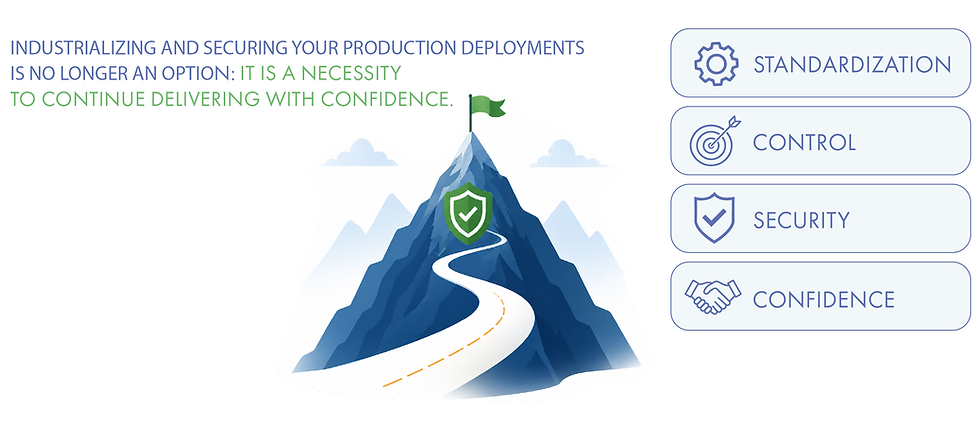
A production deployment error can be extremely costly; but more importantly, it often reveals a deeper reality: a poorly standardized and inadequately documented technical estate, along with production processes that are insufficiently controlled and shared.
By combining more than 40 years of expertise in IT production and operations with dedicated software solutions such as E-GEN and iCAN, ISC helps organizations sustainably strengthen the security of their production deployments.